DIY Projects Electronics: A Complete Guide for Enthusiasts
Introduction
Stepping into the world of DIY projects electronics is like opening a door to a universe where your imagination meets physical reality. Many people feel intimidated by circuitry, but DIY projects electronics are actually quite accessible if you start with the right mindset and tools. Engaging in DIY projects electronics allows you to understand the inner workings of the gadgets you use every day, from simple flashlights to complex smart home systems. These DIY projects electronics serve as a practical classroom where failure is just a step toward a working prototype. By spending time on DIY projects electronics, you develop a unique set of skills including soldering, circuit design, and logical debugging. Whether you are a student looking for a hobby or a professional wanting to sharpen your skills, DIY projects electronics offer endless opportunities for growth and innovation. The beauty of DIY projects electronics lies in the satisfaction of seeing an LED blink for the first time or hearing a speaker produce sound from a board you built yourself. This detailed guide will walk you through various levels of DIY projects electronics to help you become a confident maker.
Essential Tools Needed for DIY Projects Electronics
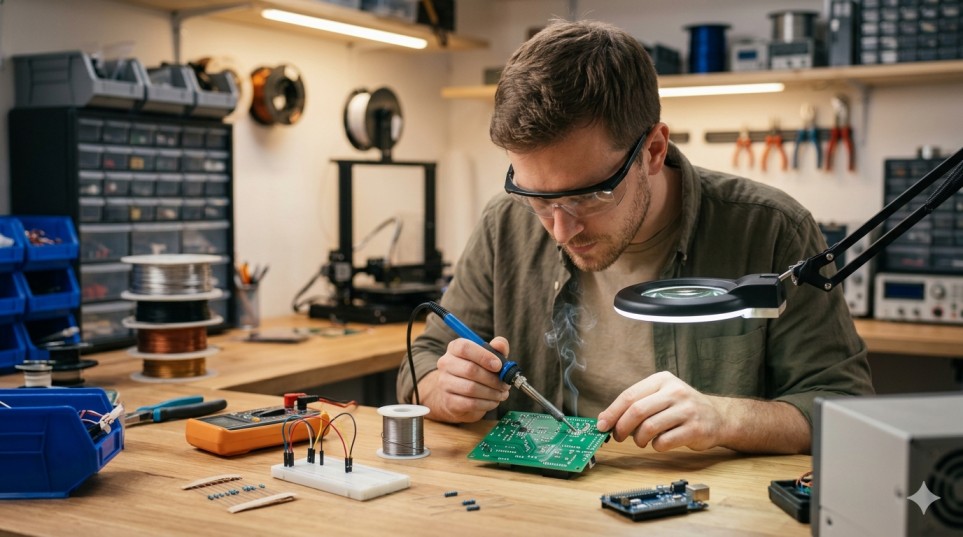
Before you begin your journey with DIY projects electronics, you must gather a basic toolkit to ensure your safety and success. Every person attempting DIY projects electronics needs a reliable soldering iron, a pair of wire strippers, and a high-quality multimeter for testing connections. Without these basic instruments, DIY projects electronics can become frustrating and difficult to troubleshoot when things don’t work. Having a dedicated workspace for your DIY projects electronics helps keep small components like resistors and capacitors organized. Many beginners in DIY projects electronics also invest in a breadboard, which allows for testing circuits without permanent soldering. As you progress to more advanced DIY projects electronics, you might find yourself needing an oscilloscope or a variable power supply. Proper preparation with the right tools makes DIY projects electronics much more enjoyable and professional in appearance. Remember that the quality of your DIY projects electronics is often reflected in the precision of the tools you use daily.
| Tool Name | Primary Use |
|---|---|
| Soldering Iron | Joining metal components permanently |
| Breadboard | Testing circuit designs temporarily |
Understanding Components in DIY Projects Electronics
To master DIY projects electronics, you must first understand the “alphabet” of electronic components. Resistors, capacitors, and diodes are the building blocks of almost all DIY projects electronics you will encounter. Each component plays a specific role in DIY projects electronics, such as limiting current or storing electrical energy for later use. Reading color codes on resistors is a fundamental skill for anyone serious about DIY projects electronics. Transistors are another vital part of DIY projects electronics, acting as switches or amplifiers within a circuit. Integrated circuits, or ICs, pack thousands of functions into a tiny chip, making advanced DIY projects electronics possible in small form factors. If you don’t understand how these parts interact, your DIY projects electronics may fail or even short circuit. Taking the time to study each part ensures that your DIY projects electronics are safe and functional. Knowledge of components is the backbone of successful DIY projects electronics execution.
| Component Type | Functional Role |
|---|---|
| Resistor | Slows down the flow of electricity |
| Capacitor | Holds a charge like a tiny battery |
Beginner Level DIY Projects Electronics: LED Circuits
The best way to start with DIY projects electronics is by building a simple LED flasher or a light-sensitive nightlight. These basic DIY projects electronics teach you how to complete a loop and ensure the polarity of components is correct. Working on entry-level DIY projects electronics builds the muscle memory needed for more complex soldering tasks later on. A light-sensing DIY projects electronics task usually involves a photoresistor that changes resistance based on ambient brightness. Seeing an immediate visual result in these DIY projects electronics provides the motivation to keep learning. Most beginner DIY projects electronics can be powered by a simple nine-volt battery or a USB connection. You will find that these DIY projects electronics are very forgiving if you make a small mistake. Starting small with DIY projects electronics is the secret to long-term hobbyist success.
Microcontrollers in DIY Projects Electronics
The introduction of microcontrollers like Arduino and ESP32 has revolutionized the world of DIY projects electronics. These small programmable boards allow you to add “brains” to your DIY projects electronics, enabling them to make decisions based on sensor input. You can program DIY projects electronics to move motors, display text on screens, or even connect to the internet. Learning a bit of code is now a requirement for the most exciting DIY projects electronics currently trending. These DIY projects electronics often serve as the foundation for robotics or home automation systems. Using a microcontroller in DIY projects electronics means you can change the behavior of your hardware without changing the wiring. This flexibility makes DIY projects electronics much more powerful and versatile than traditional analog circuits. Every modern enthusiast should explore the digital side of DIY projects electronics.
| Controller Type | Best Use Case |
|---|---|
| Arduino Uno | General learning and simple automation |
| ESP32 | Wireless communication and IoT tasks |
Audio-Based DIY Projects Electronics
Building your own amplifiers or guitar pedals is a favorite niche within DIY projects electronics for music lovers. These DIY projects electronics focus on signal processing and ensuring that sound quality remains crisp and clear. Creating a custom speaker box is one of the most rewarding DIY projects electronics because it combines woodworking with circuitry. Many people start these DIY projects electronics by modifying existing equipment to achieve a unique “vintage” sound. Audio DIY projects electronics require a good understanding of interference and shielding to prevent unwanted buzzing noises. As you refine your DIY projects electronics in the audio field, you will learn about gain, frequency response, and impedance matching. These DIY projects electronics allow you to hear the results of your hard work in high fidelity. Audio-related DIY projects electronics are perfect for those who want a functional end product for their home.
Power Supply and Battery DIY Projects Electronics
Managing energy is a critical skill for any creator of DIY projects electronics. Building your own bench power supply is a rite of passage for many people who enjoy DIY projects electronics. These DIY projects electronics teach you about voltage regulation and how to safely convert AC power from a wall outlet to DC power for your bench. Understanding lithium-ion battery management is also essential for portable DIY projects electronics. You must include protection circuits in these DIY projects electronics to prevent overheating or fires. Solar-powered DIY projects electronics are also gaining popularity as people look for sustainable ways to power their inventions. Learning to manage power effectively ensures that your DIY projects electronics are reliable and long-lasting. Safe power handling is the most important rule in the world of DIY projects electronics.
| Power Method | Advantage for Makers |
|---|---|
| Wall Adapter | Consistent power for stationary devices |
| Lithium Battery | Portability for mobile and wearable tech |
Smart Home and IoT DIY Projects Electronics
The “Internet of Things” has opened a massive new frontier for DIY projects electronics enthusiasts. You can now create DIY projects electronics that allow you to monitor your home’s temperature or lock your doors from a smartphone app. These DIY projects electronics involve connecting sensors to a Wi-Fi-enabled chip and sending data to the cloud. Many people use these DIY projects electronics to automate their gardens by measuring soil moisture. Security-focused DIY projects electronics, like motion-activated cameras, provide peace of mind at a fraction of the commercial cost. Working on IoT DIY projects electronics requires a basic understanding of networking and data protocols. As our homes become smarter, the demand for custom DIY projects electronics continues to grow rapidly. These DIY projects electronics truly bring your living space into the future.
Troubleshooting Common DIY Projects Electronics Issues
No matter how experienced you are, you will eventually encounter a problem with one of your DIY projects electronics. Troubleshooting is an essential part of the DIY projects electronics process and involves systematically checking for loose wires or burnt components. Using a multimeter to check for continuity is the first step in fixing broken DIY projects electronics. Often, a simple “cold solder joint” is the reason why DIY projects electronics fail to turn on. Learning to read a schematic diagram is vital for diagnosing DIY projects electronics that aren’t behaving as expected. Don’t be discouraged when your DIY projects electronics don’t work on the first try; it’s a natural part of the learning curve. Every mistake made during DIY projects electronics is a lesson that makes you a better engineer. Persistence is the key to mastering DIY projects electronics.
| Common Issue | Likely Solution |
|---|---|
| Circuit won’t start | Check battery voltage and wire connections |
| Overheating parts | Verify resistor values and polarity |
Safety Precautions in DIY Projects Electronics
Safety should never be an afterthought when you are working on DIY projects electronics. Always wear safety glasses when soldering for DIY projects electronics to protect your eyes from flying bits of wire or solder. Working in a well-ventilated area is crucial for DIY projects electronics to avoid inhaling toxic lead fumes. You should never work on DIY projects electronics that are connected to high-voltage mains power without proper isolation. Keeping a fire extinguisher nearby is a wise move for anyone experimenting with high-current DIY projects electronics. Always double-check your wiring before applying power to your DIY projects electronics to prevent “releasing the magic smoke.” Respecting the power of electricity ensures that your DIY projects electronics remain a fun and injury-free hobby. A safe maker is a productive maker in the world of DIY projects electronics.
Conclusion
In conclusion, embarking on DIY projects electronics is a journey of continuous learning and creative expression that rewards patience and curiosity. We have explored how DIY projects electronics can range from simple LED circuits to sophisticated internet-connected devices. By mastering the tools and components of DIY projects electronics, you gain the power to repair, modify, and invent technology on your own terms. While DIY projects electronics can be challenging at times, the sense of accomplishment when a circuit finally works is unmatched. Remember that every expert in DIY projects electronics started with a single wire and a dream to build something new. As you continue to practice your DIY projects electronics, you will find that the skills you learn are applicable in many other areas of life and work. Keep experimenting, stay safe, and never stop exploring the endless possibilities offered by DIY projects electronics. Your next great invention is just one of many DIY projects electronics away from becoming a reality. Enjoy the process and let DIY projects electronics light up your world.